
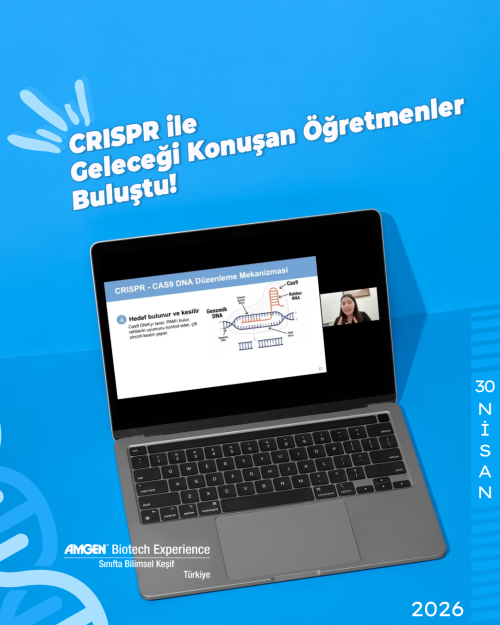
Teachers’ Meeting ‘Discussing the Future with CRISPR’ Held with High Participation
Teachers’ Meeting ‘Discussing the Future with CRISPR’ Held with High Participation
Within the scope of the ABE Program, the ““Teachers’ Meeting ‘Discussing the Future with CRISPR’ Held with High Participation” event, organized to support teachers’ professional development, was held online on Thursday, April 30, between 21:00–22:30, with the participation of Dr. Bilge Bahar Bigalke, co-founder of Çift Sarmal, and moderated by Dr. Elif Adıbelli Şahin, ABE Turkiye Program Director. Approximately 70 teachers from the ABE community and those interested in the topic participated in the event. The program stood out for its scientific content and interactive structure.
The meeting began with the opening speech of Dr. Elif Adıbelli Şahin, ABE Turkiye Program Director. Dr. Adıbelli Şahin briefly introduced the general structure and objectives of the ABE Program and the activities carried out with teachers. Then Dr. Bilge Bahar Bigalke shared the founding process of the Çift Sarmal initiative and its goals for improving scientific literacy. She also shared the current scientific topics they address on the Çift Sarmal platform and the content they plan to publish in the near future with the participating teachers.
Within the scope of the teachers’ meeting, what CRISPR technology is, how it works, and how it evolved from a natural defense mechanism into a powerful gene-editing tool were discussed in detail. Dr. Bigalke also shared her research experiences and observations regarding the use of CRISPR in biological clock studies in algae and human cells, in the production of biological products from bacteria, and in various biotechnological applications.
The current applications, technical limitations, and ethical dimensions of CRISPR technology were also among the key topics of the meeting. In this context, Dr. Bilge Bahar Bigalke discussed the first CRISPR-based therapy approved worldwide and ongoing clinical studies. In addition, diseases targeted in clinical trials and current research processes were evaluated. The reasons why the CRISPR-Cas9 system is not yet widely used as a therapeutic tool were discussed. Furthermore, the ethical responsibilities, potential risks, and ongoing debates surrounding CRISPR technology were examined in detail.
The event concluded with an interactive Q&A session enriched by active participation from teachers, turning the meeting into a dynamic scientific discussion.
The participant feedback included in the evaluation form highlights the impact of the event on teachers and the contributions it provided. All teachers who completed the evaluation form stated that the event achieved its intended objectives, was conducted in an interactive manner, contributed to their professional development, increased their professional motivation, improved their conceptual understanding of the topic, and enhanced their interest in the subject.
The teachers’ feedback demonstrates that scientist meetings provide a valuable experience for both professional and personal development. Selected participant statements are presented below:
- “Hearing scientists’ own experiences firsthand is more reliable and enjoyable.”
- “I hope the opportunities to present current scientific developments on this platform continue.”
- “Scientist meetings are seen as one of the fundamental drivers of human development.”
- “Going beyond the theoretical aspect of science and directly listening to an expert’s experience was vision-expanding and motivating.”
- “Talking with a scientist is a very valuable experience that deepens my perspective on science.”
- “The concrete examples of CRISPR-Cas9 applications in real life were very useful.”
- “Having questions answered directly by the expert in the Q&A session was very useful.”
- “It was very useful that our instructor shared examples from her own work.”
- “I formed a clear framework in my mind about the topic.”
- “It was very enjoyable to listen to an expert and learn about new developments.”