Enhancing PCR Specificity For TAS2R38 Haplotypes
Enhancing PCR Specificity For TAS2R38 Haplotypes
Authors: Hernandez, L., Leano, S.
Abstract:
TAS2R38 encodes a bitter-tasting receptor that plays a vital role in the perception of compounds that help individuals avoid ingesting harmful substances. Amplification of different target DNA sequences within this gene requires primers, which are crucial components for a successful polymerase chain reaction (PCR). However, optimal primer performance depends heavily on the intended specificity of the design, and existing studies on TAS2R38 primarily focus on taste perception rather than on primer design strategies that reliably amplify gene variants. This study focuses on designing common primers for both haplotypes, PAV (taster) and AVI (non-taster), with a focus on primer design parameters for successful amplification.
This experiment used the National Center for Biotechnology Information (NCBI) database to obtain accession numbers for the TAS2R38 gene, which were then entered into the bioinformatic platform Primer-BLAST to design candidate primers. The primers were then examined for suboptimal design features and then refined using Primer-BLAST to improve key parameters (e.g., GC content, amplicon size). Primers were then validated using gel electrophoresis and PCR to assess their amplification performance. The gel electrophoresis results reveal that the designed candidate primers were successfully validated using molecular biology techniques and successful TAS2R38 target amplification via a clean 739 bp band. The DNA ladder displays clear resolution across the agarose gel. The negative control shows no bands, revealing no contamination during reagent procurement. The positive control lane highlights the known DNA templates and verifies the expected bp bands.
Both desired control outcomes confirm the workflow's efficiency. These findings suggest that the designed common primer for both haplotypes, PAV and AVI, successfully amplified the target region, highlighting the importance of refining key primer design parameters to optimize amplification efficiency in TAS2R38 genotyping. While non-invasive toothpick extraction resulted in band variations in band intensities. Utilizing future standardized buccal swab kits will improve consistency across results and reduce inconsistent DNA yields.
Introduction:
The gene TAS2R38, also known as T2R38, encodes a bitter taste receptor that plays a vital role in the perception of synthetic compounds such as phenylthiocarbamide (PTC) and 6-n-propylthiouracil (PROP) (Bufe et al., 2005). In recent years, researchers have become increasingly interested in the TAS2R38 gene, which encodes a seven-transmembrane G protein-coupled receptor (GPCR) involved in the perception of bitter-tasting compounds, including thiourea-linked compounds such as PTC and PROP (Chandrashekar et al., 2000). Genetic variations within the TAS2R38 gene: Proline-Alanine-Valine (PAV), Alanine-Valine-Isoleucine (AVI), and Alanine-Alanine-Isoleucine (AAI) are associated with differences in taste sensitivity among individuals with different haplotype inheritance patterns, including taster, non-taster, and weak-taster. (Wölfle et al., 2016).
While the genetic variations of TAS2R38 have been extensively studied, accurate analysis of these variants depends on successful amplification of the target DNA sequence, which determines whether primers will bind and amplify the intended target sequence. However, minimal focus has been placed on ideal primer design, a critical component of a successful polymerase chain reaction (PCR) experiment, which can limit PCR specificity for these amplifying regions. (Ye. et al 2012). Therefore, careful primer design is required to optimize primer placement relative to gene structure and, where possible, minimize overlap with known single-nucleotide polymorphism (SNP) sites to ensure reliable genetic analysis.
The objective of this study is to assess whether a common primer pair can be designed to efficiently amplify the TAS2R38 target regions for both haplotype variants, PAV (taster) and AVI (non-taster). This study uses the bioinformatic software Primer-BLAST to adjust key parameters, while considering specificity, binding stability, primer efficiency, amplicon usability, and sequence quality to design primers. PCR and gel electrophoresis will then be used to evaluate amplification performance.
Methods: 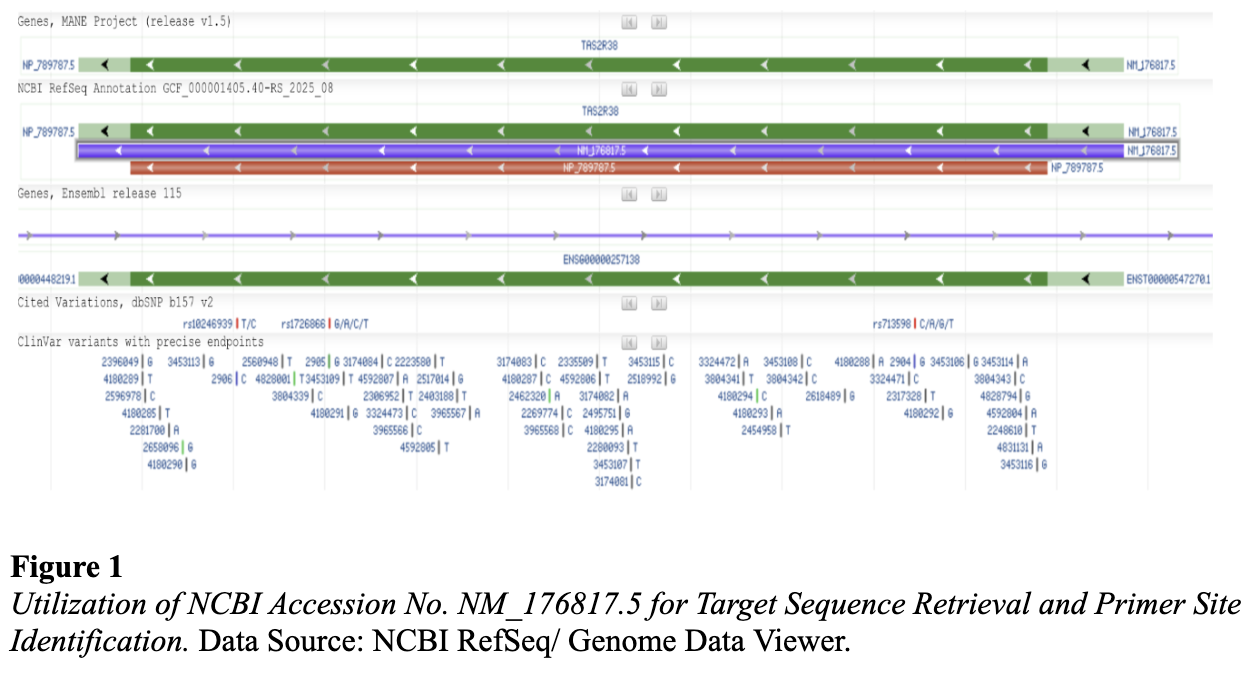
In Silico Design and Optimization:
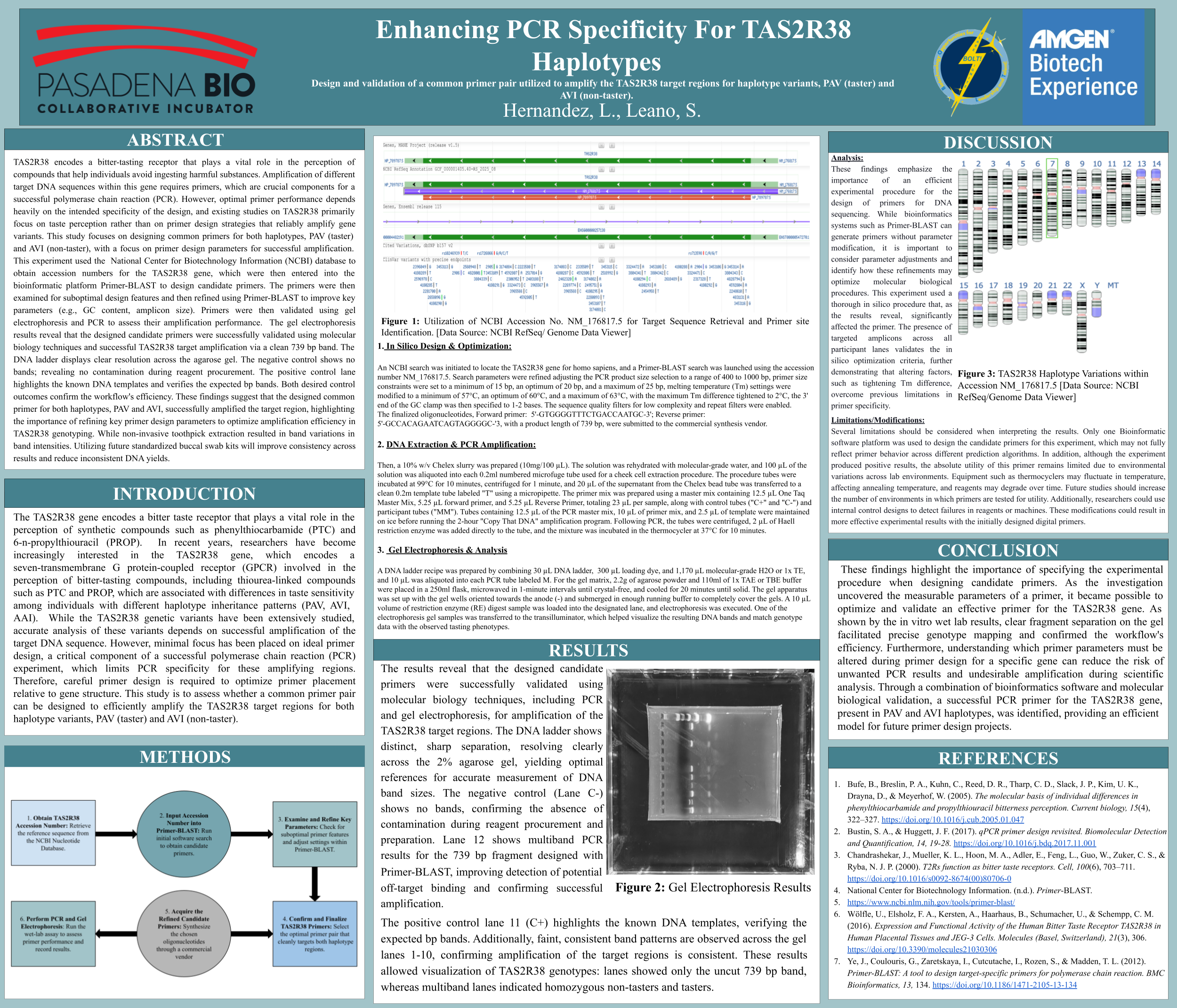
First, an NCBI search was initiated to access the National Center for Biotechnology Information database to locate the TAS2R38 gene (taste 2 receptor member 38) for Homo sapiens (see Figure 1). Under the NCBI reference sequences (RefSeq), the official RefSeq accession number in the MANE SELECT row was recorded. A Primer-BLAST search was launched using the accession number NM_176817.5 as the template box. The candidate primers generated from the launch were then examined for suboptimal features, and key parameters were refined (Bustin and Huggett 2017). Under the heading Primer Parameters, PCR product size was set to a minimum and maximum range of 400 to 1000 bp to select amplicons suitable for a downstream analysis.
Under the advanced parameters heading, primer size constraints were set to a minimum of 15 bp, an optimum of 20 bp, and a maximum of 25 bp to balance specificity and efficiency. Melting Temperature (Tm) settings were modified to a minimum of 57 °C, an optimum of 60 °C, and a maximum of 63 °C, with the maximum Tm difference tightened to 2 °C to improve PCR stability. The 3ʹ end of the GC clamp was then specified to 1-2 bases to stabilize the critical initiation site. Lastly, the sequence quality filters for low complexity were enabled, and the repeat filter was enabled to avoid unstable genomic regions.
The refined candidate primers were generated and evaluated for optimal properties, with lengths of 18-24 bases, 40-60% G/C content, and melting temperatures (Tm) of 50 °C-60 °C. The finalized oligonucleotides, Forward primer: 5ʹ-GTGGGGTTTCTGACCAATGC-3ʹ; Reverse primer: 5ʹ-GCCACAGAATCAGTAGGGGC-3ʹ, with a product length of 739 bp, were submitted to the commercial synthesis vendor.
Reagent Preparation and Cell Extraction:
Next, a 10% w/v Chelex slurry was prepared (10mg/100 µL), in which the Chelex powder was rehydrated with molecular-grade water. A volume of 100 µL of solution was aliquoted into each 0.2ml numbered microfuge tube for each participant's sample used in the cheek cell extraction procedure. Each participant first put on gloves, then performed a gentle 30-second toothpick swab inside their mouth, and finally swirled the solution in the Chelex bead tube for 30 seconds. The chelex tubes were then incubated at 99 °C for 10 minutes and centrifuged for 1 minute after incubation. A volume of 20 µL from the supernatant of the Chelex bead tube was transferred to a clean 0.2ml template tube labeled "T".
In Vitro Validation-PCR Amplification & Restrction Digestion:
Then, the primer mix was prepared using a Master Mix (MM) containing 12.5 µL of one Taq Master Mix, 5.25 µL forward primer, and 5.25 µL reverse primer, totaling 23 µL for 1 sample of working PCR master mix. A volume of 12.5 µL of master mix was aliquoted into two 0.2 mL microfuge tubes. With one tube labeled "C+" for the positive control sample and the other, "C-" for the negative control sample. 10 µL of primer mix was added to each control tube. Followed by an additional 2.5 µL of the control template into the C+ tube and 2.5 µL of diH20 into the C- tube. The tubes were maintained on ice until the other samples were ready for the thermocycler.
The Master Mix tubes were labeled "MM," and 12.5 µL of PCR master mix was pipetted into each MM tube. While keeping the MM tubes on ice, 10 µL of the primer mix was pipetted into the MM tube, and centrifuged for 5-10 seconds. The tubes were placed in the thermocycler to run the 2-hour "Copy that DNA" amplification program. Following PCR, the tubes were centrifuged to pool the liquid to the bottom of the tube. 2 µL of Haelll restriction enzyme was added directly to the tube, and the mixture was mixed by gently pipetting up and down. The tubes were then labeled "RE" to indicate that Haelll had been added, briefly centrifuged to pool the reagents to the bottom of the tube, and incubated in the thermocycler at 37 °C for 10 minutes.
Gel Electrophoresis:
A DNA ladder recipe was prepared to make 1.5 mL of a 10 µg/mL DNA ladder solution (stock: 500 µg/mL) by combining 30 µL DNA ladder with 300 µL Loading Dye and 1,170 µL molecular-grade H2O or 1x TE. Then 10 µL was aliquoted into each PCR tube labeled M. For the gel matrix, 2.2g of agarose powder was weighed and combined with 110ml of 1x TAE or TBE buffer into a 250ml flask, and swirled gently.
The flask was microwaved in 1-minute intervals, with swirling between intervals, until completely clear and crystal-free. The flask was left undisturbed on the bench top to cool for 15 minutes, then slowly poured into a prepared casting tray lined with tape and a comb, and allowed to sit for 20 minutes until completely solid.
To conclude the experiment, the gel apparatus was set up with the gel wells oriented towards the anode (-) and submerged in enough running buffer to completely cover the gels. A 10 µL volume of the restriction enzyme (RE) digest sample was loaded into the designated lane, and electrophoresis was performed at the recorded voltage and run time (e.g., 45 minutes). One of the electrophoresis gel samples was transferred to the transilluminator, which helped visualize the resulting DNA bands and match genotype data with the observed tasting phenotypes.
Results:
The results reveal that the designed candidate primers were successfully validated using molecular biology techniques, including PCR and gel electrophoresis, for amplification of the TAS2R38 target regions. The DNA ladder shows distinct, sharp separation, resolving clearly across the 2% agarose gel, yielding optimal references for accurate measurement of DNA band sizes. The negative control (Lane C-) shows no bands, confirming the absence of contamination during reagent procurement and preparation. Lane 12 shows multiband PCR results for the 739 bp fragment designed with Primer-BLAST, improving detection of potential off-target binding and confirming successful amplification.
The positive control lane 11 (C+) highlights the known DNA templates, verifying the expected bp bands. Additionally, faint, consistent band patterns are observed across the gel lanes 1-10, confirming amplification of the target regions is consistent. The presence of single-band and multiband fragment patterns following amplification of the 739 bp TAS2R38 region was consistent with the expected genotype profiles and facilitated identification of the TAS2R38 haplotypes.
These results allowed visualization of TAS2R38 genotypes: lanes showed only the uncut 739 bp band, whereas multiband lanes indicated homozygous non-tasters and tasters (see Figure 2).
Discussion:
Analysis of Results:
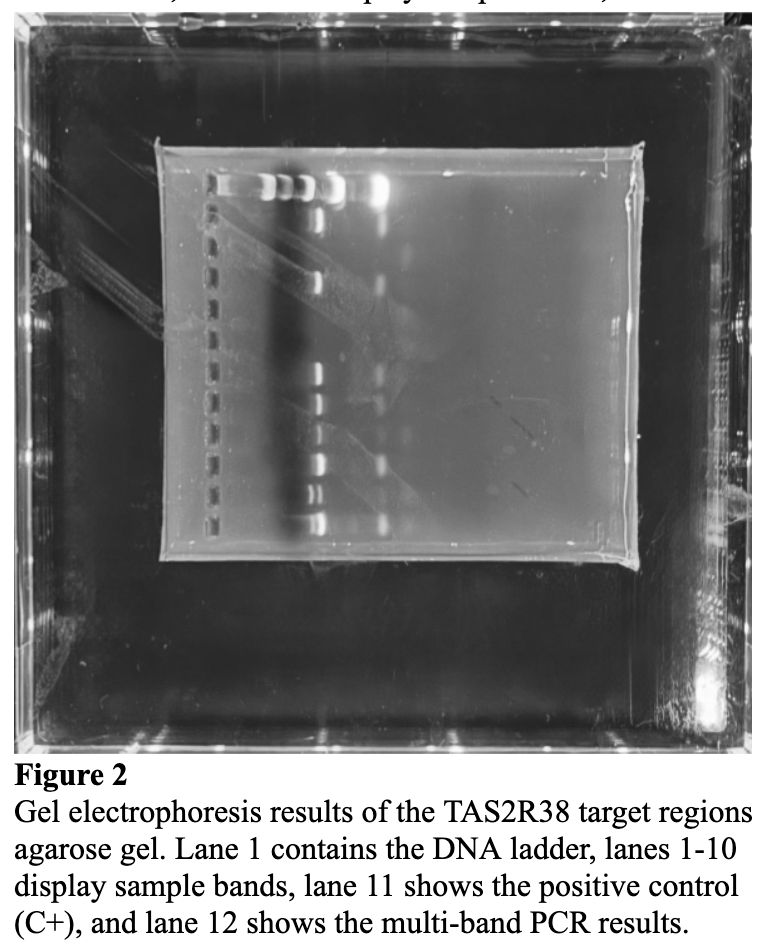
This investigation showed that a single universal primer can efficiently amplify TAS2R38 haplotypes. These findings emphasize the importance of an efficient experimental procedure for the design of primers for DNA sequencing (see Figure 3). While bioinformatics systems such as Primer-BLAST can generate primers without parameter modification, it is important to consider parameter adjustments and identify how these refinements may optimize molecular biological procedures. This experiment used a thorough in silico procedure that, as the results reveal, significantly affected the primer. The presence of targeted amplicons across all participant lanes validates the in silico optimization criteria, further demonstrating that altering factors, such as tightening Tm difference, overcome previous limitations in primer specificity. Although fainter bands did appear in some lanes during this experiment, this is a limitation that could be corrected by implementing buccal swab kits during the reagent procurement process to eliminate toothpick cheek cell extraction.
Limitations and Future Research:
Several limitations should be considered when interpreting the results. Only one Bioinformatic software platform was used to design the candidate primers for this experiment, which may not fully reflect primer behavior across different prediction algorithms. In addition, although the experiment produced positive results, the absolute utility of this primer remains limited due to environmental variations across lab environments. Equipment such as thermocyclers may fluctuate in temperature, affecting annealing temperature, and reagents may degrade over time. Future studies should increase the number of environments in which primers are tested for utility. Additionally, researchers could use internal control designs to detect failures in reagents or machines. These modifications could result in more effective experimental results with the initially designed digital primers.
Conclusion:
These findings highlight the importance of specifying the experimental procedure when designing candidate primers. As the investigation uncovered the measurable parameters of a primer, it became possible to optimize and validate an effective primer for the TAS2R38 gene. As shown by the in vitro wet lab results, clear fragment separation on the gel facilitated precise genotype mapping and confirmed the workflow's efficiency. Furthermore, understanding which primer parameters must be altered during primer design for a specific gene can reduce the risk of unwanted PCR results and undesirable amplification during scientific analysis. Through a combination of bioinformatics software and molecular biological validation, a successful PCR primer for the TAS2R38 gene, present in PAV and AVI haplotypes, was identified, providing an efficient model for future primer design projects.
References:
Bufe, B., Breslin, P. A., Kuhn, C., Reed, D. R., Tharp, C. D., Slack, J. P., Kim, U. K., Drayna, D., & Meyerhof, W. (2005). The molecular basis of individual differences in phenylthiocarbamide and propylthiouracil bitterness perception. Current biology, 15(4), 322–327. https://doi.org/10.1016/j.cub.2005.01.047
Bustin, S. A., & Huggett, J. F. (2017). qPCR primer design revisited. Biomolecular Detection and Quantification, 14, 19-28. https://doi.org/10.1016/j.bdq.2017.11.001
Chandrashekar, J., Mueller, K. L., Hoon, M. A., Adler, E., Feng, L., Guo, W., Zuker, C. S., & Ryba, N. J. P. (2000). T2Rs function as bitter taste receptors. Cell, 100(6), 703–711. https://doi.org/10.1016/s0092-8674(00)80706-0
National Center for Biotechnology Information. (n.d.). Primer-BLAST. https://www.ncbi.nlm.nih.gov/tools/primer-blast/
Wölfle, U., Elsholz, F. A., Kersten, A., Haarhaus, B., Schumacher, U., & Schempp, C. M. (2016). Expression and Functional Activity of the Human Bitter Taste Receptor TAS2R38 in Human Placental Tissues and JEG-3 Cells. Molecules (Basel, Switzerland), 21(3), 306. https://doi.org/10.3390/molecules21030306
Ye, J., Coulouris, G., Zaretskaya, I., Cutcutache, I., Rozen, S., & Madden, T. L. (2012). Primer-BLAST: A tool to design target-specific primers for polymerase chain reaction. BMC Bioinformatics, 13, 134. https://doi.org/10.1186/1471-2105-13-134