When Do Antibiotics Really Expire?: A Deep Dive Into the True Viabilities of Expired Antibiotics in Different Concentrations
When Do Antibiotics Really Expire?
A deep dive into the true viabilities of expired antibiotics in different concentrations
Authors: Lopez-Canales A., Leano, S.
Abstract:
Antibiotics are medications that are used to combat bacterial infections. Some antibiotics, like ampicillin, prevent and disrupt synthesis of the bacterial cell wall, leading to the death of the bacterium. Just like any antibiotic, the chemical compounds will degrade over time, causing them to lose effectiveness and expire. This process is hastened if improperly stored (i.e: humid areas, high heat). Over the next 50 years, it is predicted by scientists that current/standard antibiotics will eventually become ineffective. That makes this an important topic as it pertains to not just finding a potential way to combat the arms race against bacterial evolution by finding other efficacies with antibiotics; but it also could provide solutions to communities who may have a harder time getting access to antibiotics, as they might not have the resources or may even be in a drug shortage. There have been instances in which expired antibiotics have been resorted to during a shortage, so finding a proper way to up their efficiency past expiration would not only help those communities in shortages, but also prevent further development of mutated strains. This is because mutated strains may occur if an expired antibiotic is used, as that antibiotic is less potent, allowing for that bacteria to actually grow resistant and even prolong illness. A major gap in the research regarding these expired antibiotics is the fact that not much has been done in the field of finding viability in expired antibiotics and understanding a use for them, as we seem to not look into if we can find a further use past expiration. This research aims to answer the question: can ampicillin still be used effectively as an antibiotic after expiration, and if so, how? My prediction for the findings is that in high concentrations, ampicillin likely can be used to treat mild bacteria. This is based on the fact that the expiration date typically refers to when it becomes less potent, but not entirely null, so maybe a higher concentration could accommodate for the lack of potency.
Introduction:
There is an expiration date on ampicillin which is considered the point in which it has degraded to a less capable efficiency. However, this expiration date does not account for the possibility of a further use in scenarios where it does not need to function at maximum efficiency.
Previous research has been conducted in which they tested the efficiencies of expired ampicillin at varying concentrations and found that on average the ampicillin did suppress production of CC colonies when in higher concentrations. Even then, the general idea of using antibiotics past their expiration date is an underdeveloped area in laboratory research, despite the fact that it has vastly great potential implications, such as being able to assist in drug shortages when people have to resort to expired antibiotics as treatment.
The purpose of this specific experiment is to not only expand and ideally support the previous research done, but to also obtain more specific data, answering questions such as: Can ampicillin be effective past expiration? If so, in what environment? And can expired ampicillin still maintain a realistic use in medical settings?
Methods:
Preparing the Plates:
After calculating the proper dilutions for our LBA agar, two jars were obtained (one for the ampicillin plate expired from 2025, and one for expired 2023). 11.34g of LBA agar were weighed out and poured into each jar, with 324mg of DI water then poured into each. After mixing the jars properly, they were put into an autoclave to sterilize for 30 minutes. In the meantime, the calculations for the desired measurements were done. The measurements were done in grams, and are as follows: .001 (CTRL) .0005, .0025, .005, and .0075. The measurements were in increments of 25 with the exception of .0005 to .0025. Once the calculations were finished, the ampicillin was carefully weighed out and placed into weighing boats, then sealed in bags.
Plating & Spreading Colonies:
Then, the LBA agar jars were taken out of the autoclave, and then they were used to make the plates of ampicillin. The ampicillin was added incrementally into the LBA agar, and then poured into plates. Once the plates were made, they were refrigerated over three days.
After being refrigerated, the plates had TCC and CC cells spread on each side (labeled positive and negative). They were then incubated at 37 degrees celsius.
Results:
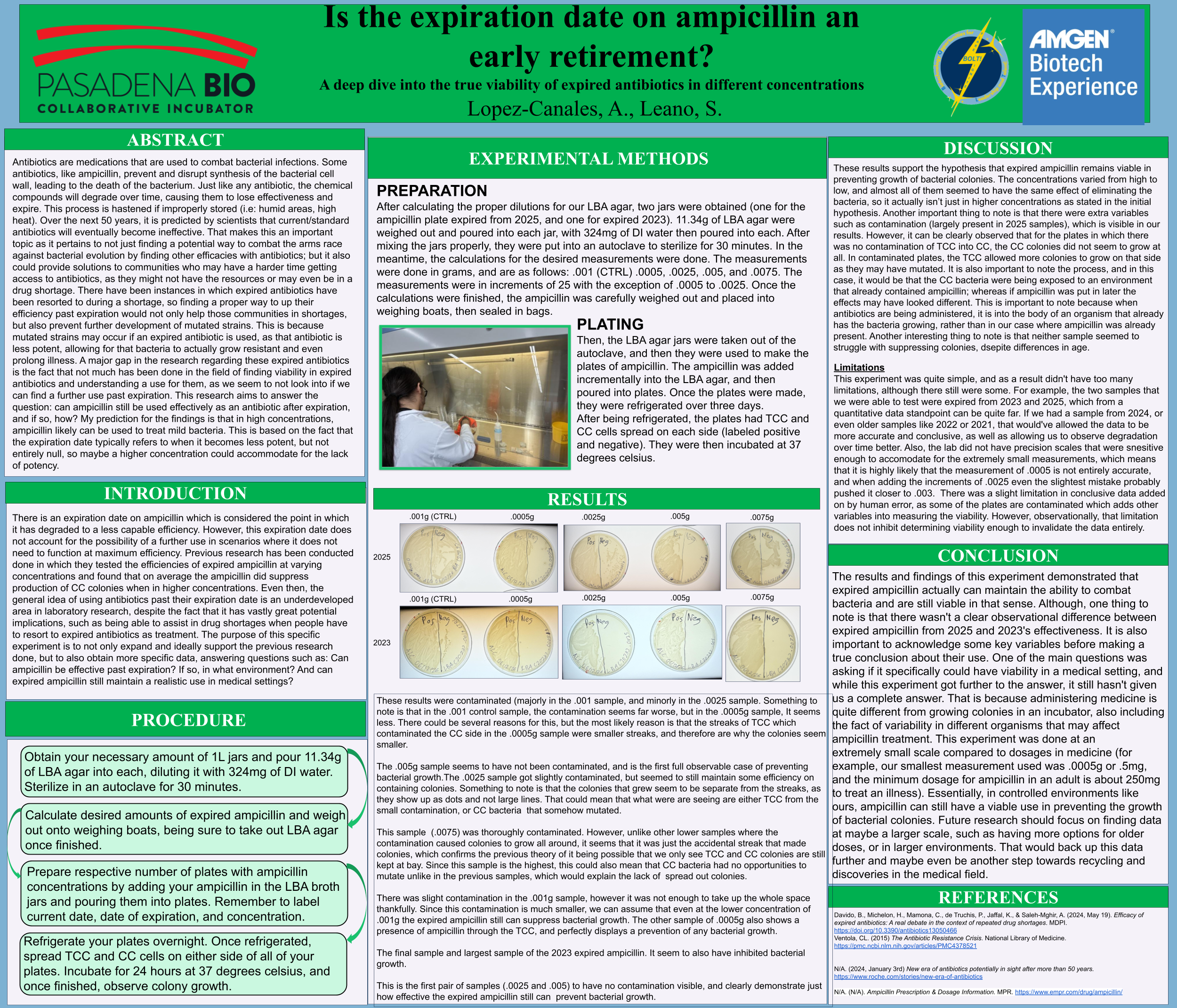
These results support the hypothesis that expired ampicillin remains viable in preventing growth of bacterial colonies. The concentrations varied from high to low, and almost all of them seemed to have the same effect of eliminating the bacteria, so it actually isn’t just in higher concentrations as stated in the initial hypothesis. Another important thing to note is that there were extra variables such as contamination (largely present in 2025 samples), which is visible in our results. However, it can be clearly observed that for the plates in which there was no contamination of TCC into CC, the CC colonies did not seem to grow at all. In contaminated plates, the TCC allowed more colonies to grow on
that side as they may have mutated. It is also important to note the process, and in this case, it would be that the CC bacteria were being exposed to an environment that already contained ampicillin; whereas if ampicillin was put in later the effects may have looked different. This is important to note because when antibiotics are being administered, it is into the body of an organism that already has the bacteria growing, rather than in our case where ampicillin was already present. Another interesting thing to note is that neither sample seemed to struggle with suppressing colonies, despite differences in age.
Discussion:
This experiment was quite simple, and as a result didn't have too many limitations, although there still were some. For example, the two samples that we were able to test were expired from 2023 and 2025, which from a quantitative data standpoint can be quite far. If we had a sample from 2024, or even older samples like 2022 or 2021, that would've allowed the data to be more accurate and conclusive, as well as allowing us to observe degradation over time better. Also, the lab did not have precision scales that were sensitive enough to accommodate for the extremely small measurements, which means that it is highly likely that the measurement of .0005 is not entirely accurate, and when adding the increments of .0025 even the slightest mistake probably pushed it closer to .003. Another limitation encountered was human error, as some of the plates were contaminated which adds other variables into measuring the viability. However, observationally, that limitation does not inhibit determining viability enough to invalidate the data entirely.
Conclusion:
The results and findings of this experiment demonstrated that expired ampicillin actually can maintain the ability to combat bacteria and are still viable in that sense. Although, one thing to note is that there wasn't a clear observational difference between expired ampicillin from 2025 and 2023's effectiveness. It is also important to acknowledge some key variables before making a true conclusion about their use. One of the main questions was asking if it specifically could have viability in a medical setting, and while this experiment got further to the answer, it still hasn't given us a complete answer. That is because administering medicine is quite different from growing colonies in an incubator, also including the fact of variability in different organisms that may affect ampicillin treatment. This experiment was done at an extremely small scale compared to dosages in medicine (for example, our smallest measurement used was .0005g or .5mg, and the minimum dosage for ampicillin in an adult is about 250mg to treat an illness). Essentially, in controlled environments like ours, ampicillin can still have a viable use in preventing the growth of bacterial colonies. Future research should focus on finding data at maybe a larger scale, such as having more options for older doses, or in larger environments. That would back up this data further and maybe even be another step towards recycling and discoveries in the medical field.
References:
Davido, B., Michelon, H., Mamona, C., de Truchis, P., Jaffal, K., & Saleh-Mghir, A.
(2024, May 19). Efficacy of expired antibiotics: A real debate in the context of repeated drug shortages. MDPI. https://doi.org/10.3390/antibiotics13050466
Ventola, CL. (2015) The Antibiotic Resistance Crisis. National Library of Medicine.
https://pmc.ncbi.nlm.nih.gov/articles/PMC4378521
N/A. (2024, January 3rd) New era of antibiotics potentially in sight after more than 50 years. https://www.roche.com/stories/new-era-of-antibiotics
N/A. (N/A). Ampicillin Prescription & Dosage Information. MPR.
https://www.empr.com/drug/ampicillin/